

Making Time to Achieve Your Goals
In this assignment, I have followed techniques of structuring time to achieve effective coordination between the academic, career, and personal life. Using prioritization techniques, implementing the time-blocking method, and using helpful resources I developed a schedule where I could accomplish all the tasks I had and meet all my responsibilities. It also allowed me to practically manage my time well and balance between work and play.
Estimating Task Completion Times Using the Time Management Calculator
To ensure that I work according to time, I used the Time Management Calculator of Capella University to determine the number of hours I devote to various tasks in a week (Capella University, 2024). As I entered estimates introduced to each class, I got an understanding of my present workload and possible changes. For coursework, I spent 15 hours a week, 2 hours on weekday evenings before work, and more hours on the weekend for heavy sessions. I allotted 56 hours a week for sleep, by sleeping 8 hours a day to avoid getting easily tired during my work. Meals consumed, thus estimated to be 10.5 hrs/week consuming 1.5 hrs per day for preparation and clean-up Besides, I devoted 2.5 hrs/week for exercise through morning 30-min sessions; five days a week. The time spent with families was dictated to be 5 hours a week which was on Friday and Sunday evenings and I decided to devote 5 more hours to simply relaxing with books or shows.
Upon computation of these hours, I checked the available hours which I had to adjust to avail a realistic period to pursue personal and academic objectives (Indeed, 2024). It made me realize where my time goes and also helped create space for important tasks, making every week productive. Resulting from this process was the direction toward better organization of my time about achieving academic success and personal satisfaction. This kind of self-reflection also helped me refine that list and minimize interruptions so I can concentrate more on what is important. Thus, those changes make me feel as if I have regained some flexibility which makes me better placed to handle competing demands.

Time Estimation for Tasks
The duration of each task was estimated based on my available schedule and by splitting my work into intervals. For coursework, I scheduled 15 hours a week depending on the amount of workload in school I scheduled it for 2 hours in the evening on weekdays and the rest of the time during the weekend. Sleep was given 56 hours a week to get a night sleep of approximately 8 hours a week for efficiency at work. Meal time was calculated to be 7.5 hours weekly with 0.5 hours set aside for preparation in addition to those for cleanup. Aerobic activity was prescribed at 2.5 hours per week, 5 days a week with 30 minutes a day in the morning (Cleveland Clinic, 2020). Both family time and leisure activities were equiponderant, with family time with five evenings weekly while leisure activities were spread over the week with five designated evenings for it being on Friday and Sunday evenings. These estimates were put based on what I consider important and in a bid to have a balanced working schedule and other activities.
Prioritizing Six Tasks for the Week
Having prioritized my goals and needs, and understood the structure of a week, I singled out six basic activities that must be performed depending on the urgency, deadlines, and objectives. All these activities cut across academic, career, and personal/family life activities. Here are the key points:
- This task was the second most emergent as it concerns the deadline/grade. It belongs to the first level of this approach because it needs to be prioritized first.
- This is the fifth most important and reminiscent of the earlier classification of being a relevant but less urgent task. I managed to spare some time for it during my midweek study sessions.
- This was the most important element as compared to the others since it can be a timely chance for professional development not to mention access to business networks/meet-and-greet.
- This is a must-do task for work and since it is not urgent, the task was accomplished after completing all my assignments but before the retreat.
- Personal/Family: Family Dinner: Placed as the third, this was a good time to fore Gather the Family was key since top work demands had to be met.
- This is good for my health and helps me used to dealing with stress but this was listed last because there will be more work this week. To avoid getting an injury I made sure I split my morning exercise sessions throughout the morning.
All these six points enabled me to manage time management by engaging myself in other academic, career, and personal issues without underestimating other important duties.
Priority Ranking Rationale
When the evaluation criteria of the tasks to be accomplished were done, the urgency, deadlines, and personal goals were considered as the priority ranking factors. An activity that was more valued and more time-consuming was given higher priority and that is why the midterm assignment was given that ranking, while an activity like the weekly quiz where there is no strict deadline assigned to it, was ranked down. Career activities like going to the work retreat were ranked highest because were an opportunity to grow in the profession and also mandatory while the project for the team meeting had more flexibility and could be done after some class work (Education Advance, 2023).
Family issues were also taken into consideration; the choice where family dinner was highly important for getting a work-life balance, and exercise was lightly considered because of more working days in a week, but still, it was stated to do, to have enough strength. It helps to address first those assignments that are more important and relevant to the client and his/her company while still providing for his/her/their well-being.
Task Organization and Calendar Overview
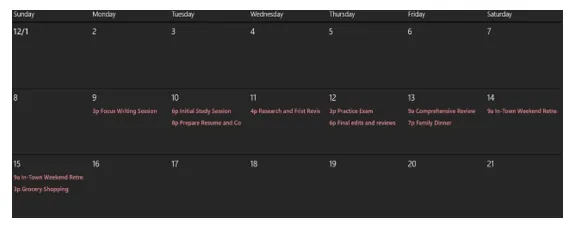
To ensure that I prioritize my tasks, I drew a calendar in terms of days of the week, and assigned time slots for each task depending on the level of importance that the task required. This system also allowed me to work on higher priority matters such as the midterm assignment and work retreat since sufficient amounts of time and attention can be given to them. Less important commitments such as exercising were also slotted in between other more important tasks so as not to disrupt other commitments. It also made sense to color-code based on category (academic, career, and personal/family) to better simplify the subtasks involved in this domain (Gragnano et al., 2020). This assisted me in achieving set working goals and overcoming possible personal and work procrastination to meet deadlines besides maintaining the work-personal life balance.
The screenshot below is a clear depiction of my week’s schedule and shows how everything is well-scribed and compartmentalized; each activity has to be well presented, marked by its color which represents the degree of urgency of the task. It was helpful to get a visual of what my time looked like and where I was spending most of my time, so it was easy to make changes that needed to happen. It also helped me track if I was being productive and balancing my academic and career as well as family and other responsibilities to avoid overstressing myself on certain areas while neglecting others plus make sure that my Gantt chart and timelines were workable.
The rationale for Choosing a Time Organization Strategy
Due to this, I chose the prioritization method that categorized the tasks according to their urgency and need to be done, as suggested by MacKay’s tips for prioritizing your work. The described approach also helps to divide the day into providing priorities to tasks with due dates and higher priority in comparison with the tasks that do not have due dates but are still important. For instance, the moment that was considered as an utmost importance was the mandatory work retreat, since it was important for my career growth and I prioritized it over all others; the second option was the midterm assignment as it was related directly to my grade improvement and it is better to do it as early as possible to avoid stress at the end of the week. Organizing work with the help of this method lets me see the scope of my work and actions and lets me prioritize tasks and when some of them are more urgent than others they can be set on that day (Bishop, 2023).
I also used materials that complied knowledge I employed about duties and task management. A blog about prioritizing tasks by MacKay was helpful, as it recommended ways how to group tasks in terms of their importance and urgency to identify the proper sequence for task completion. Also, a time management article from Capella’s library highlighted how work should be separated from personal time, and thus, I followed this idea by referring to specific hours for families and fun (Capella University, 2024). Using these resources they created a schedule that enabled me to follow a routine and avoid pressure while also balancing my work and personal life throughout the week.
Resources Informing the Task Management Process
MacKay’s Prioritization Blog was used in the mechanism that classified the working tasks according to their priorities and deadlines so that I could identify the sequence of task completion accordingly. Several examples were given in this blog that were helpful when you are ranking tasks – things I do in my academics, my career, and my personal life. A Library Article on Time Management from Capella’s library assisted me in how to juggle work and time for my family and have fun as a way of balancing my personal professional and career life while pursuing my academic goals (Capella University, 2024).
Impact of the Required Work Event on Time Organization
The work retreat that was required during the weekend played a major role in learning how to better organize time (Indeed, 2024a). The retreat was for 6 hours on Saturday and 4 hours on Sunday guided me to align other activities to meet the time needed to engage in the process fully. Since this event is pushing my professional development, I gave it the highest importance and shifted the timing of other tasks to accommodate this event. For this work event, I had to change all my academic and personal tasks to earlier in the week. For instance, I changed my midterm assignment date due to class conflict to Thursday and Friday, to allow concentrated participation in the retreat during the weekend.
Resources and Critical Thinking Used to Overcome Planning Challenges
To do this, I employed the use of a time management guide and did some analysis on time management. I recalled MacKay’s prioritization strategies, namely planning to avoid fixed commitments e.g. the mandatory staff work retreat (Fibery, 2024). Organizing this event as the central part of the week and building other tasks around it helped me not to overload myself. Also, since I understood the retreat would consume most of my weekend, I rearranged work to ensure that tasks were accomplished during the week. It enabled me to effectively move forward in the academic and other areas of life, when, for example, all the requirements are met at work without exhaustion, could set priorities, and distribute tasks more efficiently.
Reflection on the Credibility and Relevance of a Chosen Resource
To help me make changes in terms of time management and priorities, I chose an article from Capella Library concerning time management strategies (Capella University, 2024). To measure credibility, I looked into the author, source, and whether the pieces have any backing from research. It was very useful since the article was in a professional journal that was devoted to productivity and I required information on productivity. It offered information on the sorting of tasks foremost by their level of urgency and secondly by their significance, which was a direct guide towards the completion of the assignment. From this method, I was able to establish an effective plan of work that meant that I was able to accomplish certain important tasks within a given period all of which did not compromise my health.
The techniques of time management were used as appropriate to the particular assignment (Simplilearn, 2022). The prioritization methods helped to find out the academic, career, and personal activities and how to manage the time to do the urgent constructive activities and ensure that I do not miss my other important activities in life. Moreover, the article also taught me about time-blocking methods for which I planned my weekly schedule. This approach also helped me to plan for my daily schedules most effectively by attracting adequate time for each activity without leaving my agenda fully congested in a way that would lead to work fatigue.
Relevance of Resources to Assessment
Certain features of the assessment, namely the choice of the article, included such conditions as the priority of tasks and the concerns of the subjects regarding their academic, work, and personal lives. I found that the article highlighted ways of categorizing the tasks according to their urgency and their overall importance which aligned perfectly with the task of prioritizing tasks according to their deadlines and their importance. Furthermore, the principles of time blocking described in the article were useful for the assessment because it was important to schedule the workflow to accommodate several tasks in a week. These aspects of the article directly fit into my strategy for planning my tasks and selecting a proper time management system.
Conclusion
Through the application of time management tools, rigorous thinking as well as credible sources of information I managed to achieve good prioritization of the tasks at hand and made some modifications over a forced mandatory work retreat. This process not only helps me to pursue academic and professional goals but also keeps the health of my mind preserved. Planning helped me to timely organize time, fulfill time-bound commitments, and balance them as well.
References
Bartlett, M. J., Arslan, F. N., Bankston, A., & Sarabipour, S. (2021). Ten simple rules to improve academic work-life balance. Public Library of Science (PLOS) Computational Biology, 17(7). https://journals.plos.org/ploscompbiol/article?id=10.1371/journal.pcbi.1009124
Bishop, C. (2023, January 11). How to prioritize tasks when everything’s important. Wework Ideas. https://www.wework.com/ideas/professional-development/creativity-culture/how-to-prioritize-tasks
Capella University. (2024). Capella University: Online accredited degree programs. Capella.edu. https://www.capella.edu/
Cleveland Clinic. (2020, July 16). Aerobic exercise health information. Cleveland Clinic; Cleveland Clinic. https://my.clevelandclinic.org/health/articles/7050-aerobic-exercise
Education Advance. (2023). 10+ Fun Career Exploration Activities: Broadening Horizons and Inspiring Futures. Educationadvanced.com. https://www.educationadvanced.com/blog/fun-career-exploration-activities
Fibery. (2024, January 26). Prioritizing Strategies: A Comprehensive Guide to Effective Decision-Making. As We May Think — Products & Tools for Thought. https://fibery.io/blog/product-management/prioritization-strategies/
Gragnano, A., Simbula, S., & Miglioretti, M. (2020). Work-Life Balance: weighing the importance of work–family, and work–health balance. International Journal of Environmental Research and Public Health, 17(3). National Center for Biotechnology Information (NCBI). https://www.ncbi.nlm.nih.gov/pmc/articles/PMC7037206/
Indeed. (2024a). 50 Fun Work Retreat Ideas for Team Building. Indeed Career Guide. https://www.indeed.com/career-advice/career-development/work-retreat-ideas
Indeed. (2024b, September 11). 10 Educational Goal Examples | Indeed.com. Indeed Career Guide. https://www.indeed.com/career-advice/career-development/educational-goals-examples
MedlinePlus. (2024, July 12). Benefits of exercise. Medlineplus.gov; National Library of Medicine. https://medlineplus.gov/benefitsofexercise.html
Simplilearn. (2022, May 11). Top Proven Time Management Tips & Strategies for Students | Simplilearn. Simplilearn.com. https://www.simplilearn.com/tutorials/time-management-tutorial/best-time-management-tips-for-students